Client
She Grows Veg
Period Measured
Dec 2023 – Jun 2024
Data Sources
GA4 – Search Console – SEMrush
Website
Designed & Built by Reach

Achieved five-figure monthly revenue from organic search within the first 6 months.
Referring domains: 52 → 245
Ranking keywords: 133 → 1.6k
Site health score: 79 → 92
“Heirloom seeds” keyword: #9 → #1 (Dec → Mar)
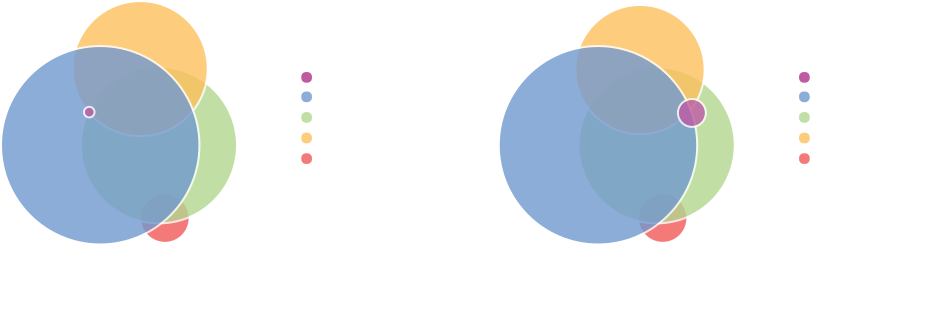
SEMrush Keyword Gap (UK) — baseline vs latest snapshot: growth in She Grows Veg’s ranking organic keywords (133 → 1.6k) and competitive overlap over the campaign period.
To win quickly in a crowded category, we started by analysing the brands already owning visibility and reverse-engineering what was driving their performance.
Keyword gaps and topic opportunities: we identified where competitors were winning rankings and where She Grows Veg could capture demand faster with clearer intent matching and a better page experience.
Which content was actually driving traffic: we mapped the pages and formats sending users to competitors, not just the keywords they ranked for, but the content types converting attention into sessions.
How competitor SEO was structured: we assessed category coverage, internal linking patterns, and the role informational content plays in supporting product discovery.
Competitors weren’t winning solely through product pages. A meaningful proportion of their acquisition came through informational ecosystems that feed commercial discovery (for example, one competitor snapshot showed 60.3% informational traffic-driving content), validating the need for a content engine built to support category performance, not a blog for blogging’s sake.
We designed the strategy to compete quickly by prioritising execution in three stages:
A major challenge for any new e-commerce site is credibility. Search engines and customers need reasons to trust a new brand. From the start, we focused on building trust signals and content depth that reflected real expertise: heirloom knowledge, seasonal growing guidance, and product pages with genuinely useful detail that deserved to rank.
This was accelerated by a strong working relationship with Lucy and Kate. Kate’s marketing background meant she quickly understood the technical rationale behind our SEO recommendations, which helped us move quickly and stay aligned on priorities. We also had early conversations about authority-building through backlink acquisition, explaining why high-quality editorial links matter for a new site competing against established retailers.
Lucy and Kate then took the lead on the digital PR plan. While they understood the SEO value, their approach wasn’t “links for links’ sake” — it was credible coverage that builds brand trust and reaches new audiences. Leveraging Lucy’s growing Instagram network, they secured features and earned links from reputable publications including Ideal Home, The English Garden, and The Independent. As a result, She Grows Veg’s referring domains grew from 52 to 245 over the campaign period.
Prioritise categories and content around the moments people are closest to purchase — “money” category terms (e.g., heirloom seeds, veg seed varieties) supported by seasonal and beginner-intent guides (“what to sow now”). This ensured informational demand didn’t end at a blog post, but consistently routed users into product discovery via internal linking, navigation and on-page merchandising.
Once the foundations and priority categories were in place, we scaled into long-tail demand — crop/variety pages and intent-matched guides that attract growers with clearer needs (and higher propensity to buy). Every new page was built to feed the commercial catalogue through internal linking, navigation, and “next step” pathways into the most relevant categories and products.
We built the site with SEO baked in from the start, so Google could clearly understand what She Grows Veg sells, and shoppers could easily browse and discover new varieties. That meant putting an SEO-led structure in place across the core product categories, while also creating pathways for long-tail searches around specific varieties. On key pages, we introduced repeatable patterns that tend to perform well in search, clearer, more scannable layouts and sections that answer common questions (including FAQ/PAA-style formatting where it made sense), so visitors landed on pages that felt helpful and purchase-ready, not confusing.
Behind the scenes, we focused on removing the technical friction that stops new sites from scaling. We ran a site health audit and improved the overall score from 79% to 92%, resolving issues like duplicate meta titles/descriptions, broken internal links, missing meta descriptions, missing H1s and redirect problems.
This work matters because it improves crawlability and indexing, reduces dead ends for users, and creates the stable foundation that allows rankings to grow and stick.
Alongside that, we built a content system designed to compound over time. Instead of publishing ad hoc posts, we planned content to capture seasonal and informational demand, the kinds of searches new growers make when they’re deciding what to sow and when — and then guide those users towards the most relevant categories and products through internal linking. This was supported by ongoing auditing and optimisation planning, including expanding landing page coverage, strengthening internal links and improving navigational discovery as performance data came in.
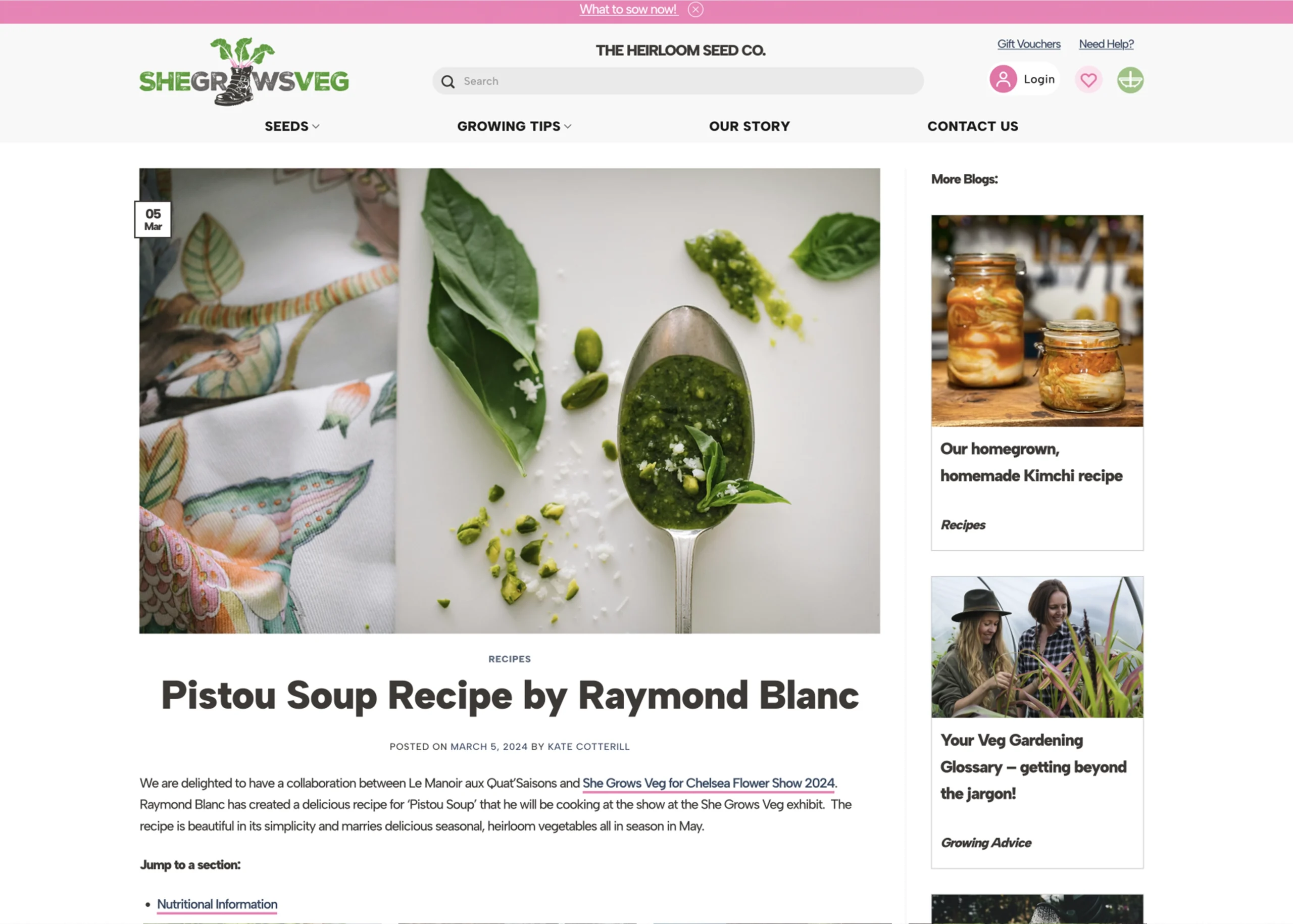
Example of Recipe schema markup in action, helping She Grows Veg earn enhanced recipe results in the SERPs.
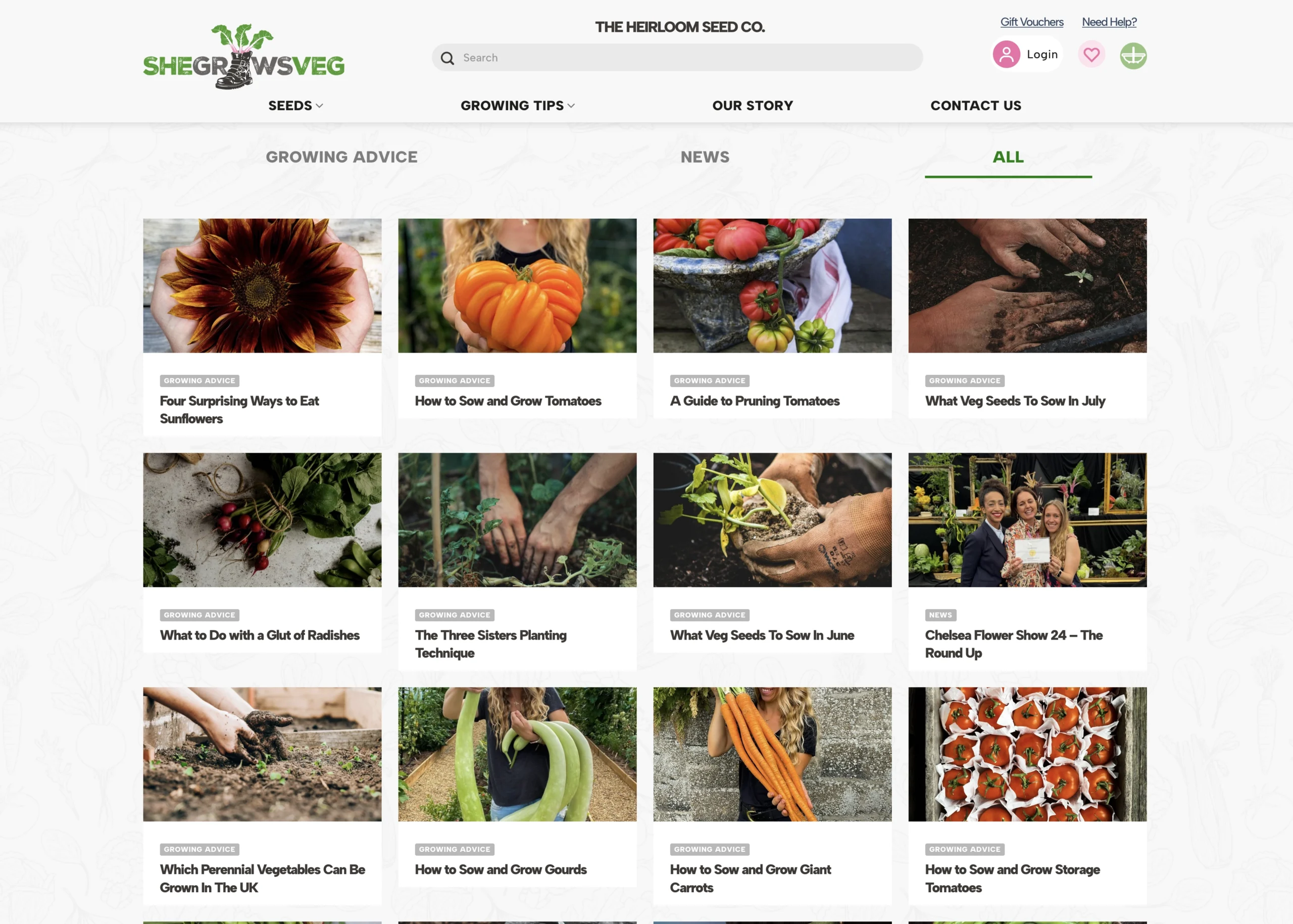
SEO-led content hub: guides + recipes built to capture discovery intent and drive product discovery.
As the brand grew, searches for She Grows Veg naturally increased, but the strongest signal of SEO impact wasn’t the brand query volume. It was where Google sent users.
Across the campaign period, 48.8% of organic clicks landed on non-homepage pages, meaning search traffic wasn’t simply navigating to the brand, it was discovering She Grows Veg through product, category and informational intent and entering the site at the point of relevance.
In practical terms, Google was sending users directly into the ecommerce journey:
23.1% of organic clicks landed straight on product pages, showing demand capture at SKU/variety level.
15.0% landed on category pages, indicating strong commercial visibility for “money” searches.
9.5% landed on content-led pages, supporting discovery and then feeding browsing behaviour into the catalogue.

48.8% of organic clicks landed beyond the homepage, showing Google was sending users directly into the ecommerce journey.
Source: Google Search Console (exported performance data), Dec 2023–Jun 2024.
This is the commercial value of SEO done properly: building an acquisition engine that performs beyond brand recognition, capturing new customers through non-brand intent and turning that demand into ecommerce revenue.
Achieved five-figure monthly revenue from organic search within the first 6 months. This highlights SEO became a key commercial channel at the very start of the season, demonstrating a fast route to the top of SERPs.
Pages driving that growth reflect the strategy working as designed:
Seasonal informational page, “The Best Veg Seeds to Sow in May, surged as an entry point.
Commercial pages also climbed: “Heirloom Seeds” and “Shop Heirloom Veg Seeds” performed strongly, showing that discovery translates into shopping behaviour.
A core commercial keyword, ‘heirloom seeds’, moved from Position 9 in December to Position 1 by March. For a new ecommerce brand comepting against major retailers, this was a huge authority signal by winning key cateogry defining searches.
A key driver of the pace of growth was how quickly decisions were made and implemented. Priorities were agreed early, changes were actioned without delay, and the roadmap evolved based on performance data. That rhythm allowed us to stay focused on the highest-impact actions first, then iterate and expand what was proving effective.
This strategy wasn’t about publishing more content and hoping it ranked. It worked because:
Architecture captured commercial intent: category-led structure supported both rankings and conversion pathways.
Content expanded reach and fed product discovery: informational and seasonal pages brought in demand, then passed users into commercial journeys via internal linking.
Technical hygiene removed friction: improving site health ensured search engines could crawl and index efficiently, and users had a smoother experience.
Competitor insights informed speed-to-impact: we focused on credibility first, then high-intent coverage, then scaled volume — giving She Grows Veg a roadmap to outrank established retailers at pace.
If you’re an eCommerce brand looking for predictable organic growth, we’ll review your site, pinpoint the biggest opportunities, and share a clear 90-day action plan.
Explore our SEO Services Book a strategy call