

In one of the longest-running annual surveys of B2B marketers, 56% say they can’t attribute ROI to their content, and the same share say they can’t effectively track the customer journey. That’s marketers whose job is measurement, answering directly, landing on “we don’t know.” For a business without anyone dedicated to watching this at all, the real number is almost certainly worse.
Traffic can go up. Impressions, engagement, reach. All of it can climb, and still tell you almost nothing about whether the spend is working. Those numbers measure attention, not outcome. Take SEO. Average position climbing, impressions up. That’s real evidence the method’s working, better rankings, more visibility. It’s just not evidence it’s making the business any money. Same story over in organic social. Reach and engagement going up is proof people are seeing the content. Whether that’s worth anything commercially is a completely different question, and it’s not one those numbers can answer on their own.
If you can’t attribute a lead, a sale, or a pound of revenue back to the activity that produced it, you’re not managing marketing, you’re watching it and hoping. Every decision after that point, what to fund, what to cut, what to scale, isn’t really a decision. It’s a guess.
That’s the actual argument for tracking. Not that it’s good practice, or that it makes reporting tidier. It’s that without it, there’s no way to tell the difference between marketing that’s working and marketing that just feels like it’s happening.
Most businesses aren’t tracking anything real
Ask a typical founder how marketing’s going and you’ll usually get a number of enquiries per month. Ask where those enquiries came from, and the honest answer is usually “we don’t really know.” Not because nobody cares. Because nothing was ever set up to tell them.
That’s the baseline for a lot of businesses. A monthly enquiry count, and nothing underneath it. No source, no journey, and certainly no line to revenue.
Consent mode changes across GA4 have made even the basic version of this harder. A growing share of visitors now decline tracking outright, so a chunk of your traffic is invisible by default before you’ve even started asking the harder questions. How much you lose varies drastically by industry. Across the accounts we manage it ranges from around 20-30% on the low end up to 60-70% for anything touching a sensitive subject, since people are far more protective of their privacy the more personal the topic. That’s a real, growing problem. But it’s a smaller one than never having asked what you’re trying to see in the first place.
More data isn’t the fix
The instinct, once someone notices the gap, is to want more data. Marketing managers ask for it constantly, often, if I’m honest, because a report full of charts and metrics looks good going up the chain, not because anyone’s asked what they’ll actually do with it.
The problem is that nobody has time to interpret it properly. You end up with a thick monthly report (somewhere around 10-15 pages seems to be the industry standard, for reasons nobody’s ever actually explained) full of numbers nobody fully understands, that takes real effort to produce and gets skimmed for five minutes before being filed away. More data doesn’t automatically mean more useful decisions. Past a certain point it just means more unpaid interpretation time for both sides. And it still doesn’t answer the one question that actually matters, which is what any of it was worth.
The better question isn’t “can we track more.” It’s “what are we actually tracking, and why, and does it get us any closer to a number that means something commercially.” Every button, every download, every phone call event on a website should have a reason behind it.
The questions that actually matter
Strip it back, and there are two halves to this. The first is what happens before someone gets in touch. Where did this lead actually come from, what content did they look at on the way, did they already know the business and search for it by name, or did they find it cold, are they new or have they been back before, and which pages on the site aren’t doing anything at all. Do you still need them, and is the content there giving the visitor something useful, or just trying to extract an email address from them.
The second half is what happens after they get in touch, and this is the part almost nobody measures. How quickly did someone actually respond to that enquiry? Was there a follow-up, or did it go quiet? Was the lead even relevant in the first place? Did they become a paying customer? Did they come back and buy again? What’s that customer actually worth over time?
Most businesses can answer the first half a little. Almost none of them can answer the second half at all. And that’s exactly where the money question lives.
This matters more the longer your sales cycle is
Bad tracking doesn’t cause a business to spread its marketing budget too thin. That’s a separate mistake. What it does is make the mistake much harder to spot, and that gets worse the longer the gap is between a quote going out and a sale closing. With a short sales cycle, you get feedback fast. Something changes, and within days or weeks you can see whether it moved the numbers, even if the tracking behind it is a bit rough. With a sales cycle running months, that feedback is delayed so long that by the time a deal closes, three other things have changed too, and there’s no way to tell which one actually mattered. If you can’t connect that lead back to where it came from, and you can’t see what happened to it after someone first spoke to them, you’re not managing the relationship between marketing and revenue at all. You’re guessing, and you won’t find out you were wrong for months.
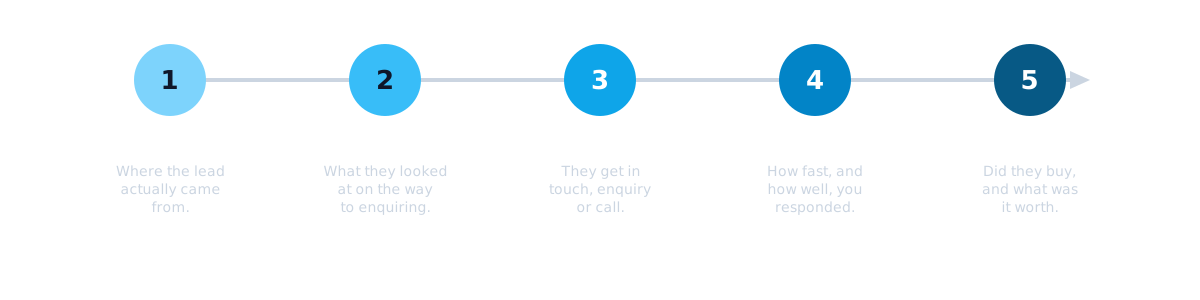
A basic example of a five stage lead journey, from source through content, contact, follow-up and outcome.
What “enough” tracking actually looks like
You don’t need a full CRM platform to fix this. What you need is something robust enough to follow a lead from the moment they arrive on your site through to the point they either become a customer or don’t. That means source, content, contact, follow-up, outcome. That can be an established CRM, like Salesforce or HubSpot. It can be something built specifically for that job and nothing more, which is why we built our own lightweight version, Nexus, for clients who didn’t need a full CRM, just somewhere to see a lead from source through to outcome without paying for or learning software built for a much bigger sales team. Or it can be something simpler still, just a Looker Studio dashboard pulling from a spreadsheet you update by hand. The manual version takes more ongoing effort to keep current, and it won’t scale forever, but it’s infinitely better than nothing, and it’s usually where a business should actually start.
Either way, it costs something real, whether that’s a subscription, somebody’s time, or both. And that cost needs a place in the marketing budget, not a hope that it gets done for free in whatever hours are left over at the end of the week. It’s not something to put off until the business feels big enough to justify it. The earlier it’s resourced properly, the sooner every other marketing decision stops being a guess.
Lifetime value is the fullest picture, genuinely understanding what a customer’s worth once you factor in repeat business, but it’s an ongoing question, not a finish line, and it’s not where most businesses need to start. Start with knowing where leads come from and what happens to them once they arrive. Everything else, including how much a customer’s actually worth over time, gets easier to answer once that’s in place.
If you don’t know how much revenue your marketing is actually generating, you can’t know whether to feel confident in it, and you definitely can’t know what to scale or where. At that point you’re not making a decision. You’re guessing, and hoping the guess holds.
This is also, not coincidentally, the second stage of the Startup Marketing Investment Framework. Clarity first, then tracking, before conversion or acquisition get any more budget. It’s easy to treat tracking as the boring administrative step before the “real” marketing starts. It isn’t. It’s the only thing that tells you whether any of the rest of it is actually working.

About the author
Oliver Westrup
Retained Services Director at Reach Digital
Oliver Westrup is Retained Services Director at Reach Digital and the developer of the Startup Marketing Investment Framework. He works with founders and marketing teams to sequence budget, prioritise channels, and build marketing systems that hold up as a business grows.
Did you find this article useful? Share it with a friend or colleague